
Shopify vs. Wordpress 2026: Pricing, Features, SEO & Which One to Choose
Choose Shopify if you want a fully managed, ecommerce-first platform with the highest-converting checkout in the industry - best for DTC brands, scaling stores, and non-technical founders. Choose WordPress + WooCommerce if content marketing, full data ownership, or deep customization are non-negotiable - best for content-led brands, publishers monetizing audiences, and merchants with developer resources. Both platforms scale; the right call depends on how your business actually grows.
Choosing between Shopify and WordPress is one of the most consequential decisions an online merchant makes - and in 2026, the gap between the two platforms has never been more nuanced. This guide is built for merchants who need straight answers: real feature breakdowns, honest pricing comparisons, and a clear verdict based on business type. With Shopify powering an estimated 5.6+ million live stores worldwide (BuiltWith, 2026) and WordPress running more than 43% of all websites on the internet with WooCommerce holding roughly 33% of the global ecommerce platform market (Hostinger, 2026), both platforms have earned their authority. Neither is universally superior. The right choice depends entirely on your business model, technical comfort level, and growth ambitions.
Factor | Shopify | WordPress + WooCommerce |
|---|---|---|
Best For | Dedicated ecommerce stores, DTC brands | Content-heavy stores, blogs with a shop |
Ease of Setup | Very easy (hosted, guided) | Moderate to complex (self-managed) |
Upfront Cost | From $5/month (Starter) or $39/month (Basic) | Free software + hosting from ~$10/month |
Transaction Fees | 0.6%–2% (waived with Shopify Payments) | None (gateway fees only) |
Customization | Moderate (theme + app based) | Very high (full code access) |
SEO Flexibility | Good (built-in tools) | Excellent (full control) |
Scalability | High (managed infrastructure) | High (depends on hosting) |
Security & Maintenance | Fully managed | Your responsibility |
App / Plugin Ecosystem | 20,000+ apps | 63,000+ plugins |
Support | 24/7 live chat, email, phone | Community forums, third-party paid support |
AI features (2026) | Shopify Magic, Sidekick, AI image editing | WordPress 7.0 AI Building Blocks (April 2026) |
Headless commerce | Hydrogen + Oxygen | Headless WordPress + WPGraphQL |
What Is Shopify and What Is WordPress? Key Differences Explained
The perfect ecommerce platform does not exist - only the one that fits your specific business model. A merchant launching a focused product line needs a different engine than a publisher monetizing a loyal content audience. Understanding Shopify vs WordPress starts with understanding what each platform was actually designed to do.
Shopify is a fully hosted, all-in-one ecommerce platform launched in 2006 by Tobias Lütke. It was purpose-built for selling. Everything - hosting, security, payment processing, checkout, and inventory - is managed within a single ecosystem. Merchants pay a monthly subscription and can open a functional store within hours without touching a line of code.
WordPress is an open-source content management system (CMS) that powers a significant portion of the web. On its own, WordPress is a publishing platform. The ecommerce functionality comes primarily through WooCommerce, a free plugin originally launched by WooThemes in 2011 and acquired by Automattic in 2015. The WordPress + WooCommerce combination gives merchants complete ownership of their store - code, data, design, and infrastructure - but requires a hosting provider, ongoing maintenance, and a steeper technical investment.
Why does the choice matter in 2026? Platform selection has direct long-term consequences on three business pillars. First, SEO performance - your platform's URL structure, page speed, Core Web Vitals handling, and schema markup capabilities directly affect organic rankings. Second, scalability - the platform you build on today needs to support ten times your current volume without requiring a complete rebuild. Third, profit margins - transaction fees, hosting costs, premium plugins, and developer costs accumulate differently on each platform and can meaningfully impact net revenue at scale.
Quick clarification: WordPress.org vs WordPress.com. This guide compares self-hosted WordPress.org (the open-source software you install on your own hosting) with Shopify. WordPress.com is Automattic's hosted version with different pricing and limitations and is not the focus of this comparison.
Ease of Use: Is Shopify or WordPress Easier for Beginners?
For merchants without a development background, the onboarding experience is often the deciding factor between Shopify and WordPress.
Shopify's Guided Onboarding
Shopify delivers one of the most polished setup experiences in the SaaS space. After signing up, merchants are guided through adding products, connecting a payment gateway, setting up a domain, and configuring shipping - all from a single dashboard. The admin interface uses plain language, and most tasks require no coding knowledge. Themes are applied in a few clicks. Checkout is pre-built and optimized. A merchant with no technical background can realistically launch a fully operational store within a single business day.
The trade-off is that Shopify's interface, while clean, operates within boundaries defined by the platform. Deep customizations require familiarity with Liquid (Shopify's templating language), Shopify Functions (for custom backend logic on Plus), or third-party apps.
WordPress + WooCommerce Setup Complexity
Setting up a WordPress store requires more steps. The merchant must select and pay for a hosting provider, install WordPress, install and configure the WooCommerce plugin, choose and install a compatible theme, and configure payment gateways - often each requiring its own plugin or extension. While managed WordPress hosts like WP Engine, Kinsta, and Pressable reduce some of this friction, the process demands more decision-making and technical confidence than Shopify.
The payoff is total control. Every page template, checkout field, URL structure, database record, and design element is accessible and modifiable. For merchants with development resources or technical co-founders, WordPress offers a level of customization that Shopify's closed environment cannot match.
Verdict on ease of use: Shopify wins for solo founders and non-technical merchants. WordPress is the better choice for merchants with development resources who prioritize deep customization over convenience.
Features and Flexibility: What Each Platform Actually Does Out of the Box
Shopify's Native Feature Set
Shopify's core subscription includes a full ecommerce feature set without requiring additional plugins for most standard operations. Out of the box, merchants get:
- Unlimited product listings (on all paid plans)
- Built-in inventory management with multi-location tracking
- Shopify Payments (eliminating third-party transaction fees)
- Abandoned cart recovery
- Discount codes and gift cards
- Basic email marketing (Shopify Email)
- Shopify POS for in-person sales
- Integrated shipping rates with major carriers
- Automatic tax calculations
- SSL certificate and PCI DSS compliance
- Shop Pay accelerated checkout
- Shopify Markets for international selling
Shopify's checkout is widely regarded as the highest-converting in ecommerce. Shop Pay alone can increase conversion by up to 50% over standard guest checkout, according to Shopify's internal data. During Black Friday Cyber Monday 2025, Shopify merchants generated a record $14.6 billion in sales, with peak velocity reaching $5.1 million per minute (Shopify, 2025).
WordPress + WooCommerce Feature Flexibility
WooCommerce's core plugin is free and covers the fundamental ecommerce layer: product pages, cart, checkout, basic payment gateways (PayPal, Stripe via free extensions), tax settings, and order management. The 2024–2026 release cycle introduced two major performance upgrades: High-Performance Order Storage (HPOS) for stores processing high order volumes, and Cart and Checkout Blocks for faster, block-based checkout pages.
However, many advanced features that Shopify includes by default - subscription billing, advanced product filtering, wholesale pricing, multi-currency - require additional WooCommerce extensions, many of which carry annual license fees.
Where WordPress genuinely outperforms Shopify is in content flexibility. WordPress began as a blogging platform, and its content architecture - custom post types, taxonomies, advanced editor blocks via Gutenberg - gives merchants far greater control over editorial content, landing pages, and long-form SEO assets. For businesses where content marketing and organic SEO are central to the growth strategy, WordPress's content infrastructure is a structural advantage.
Verdict on features: Shopify is more feature-complete out of the box for pure ecommerce. WordPress offers more flexibility for content-driven stores where the shop complements a broader publishing strategy.
AI Features in 2026: Shopify Magic vs WordPress 7.0
This is where the 2026 comparison diverges sharply from older guides. Both platforms made major AI investments in the last 18 months.
Shopify's AI Stack:
- Shopify Magic: AI-generated product descriptions, blog posts, and email subject lines, available across plans
- Sidekick: Conversational AI assistant inside the Shopify admin that can perform tasks (apply discounts, change inventory, generate reports) via natural language
- AI image editing: Background removal and product photo enhancement built into the admin
- Shopify Audiences (Plus only): AI-powered audience lists for paid acquisition

WordPress + WooCommerce AI Stack:
- WordPress 7.0 (release May 20, 2026) shipped with the PHP AI Client SDK built directly into core, meaning AI infrastructure is now native - no plugin required
- WooCommerce AI: Product description generation and smart inventory suggestions
- Third-party AI plugins: Jetpack AI, Elementor AI, RankMath Content AI, Bertha AI, and dozens more

Verdict on AI: Shopify's AI is more polished and tightly integrated for ecommerce-specific tasks. WordPress's AI architecture is more flexible and developer-friendly, with the trade-off that you assemble the stack yourself.
SEO Reality Check: Which Ranks Better in 2026?
This is the question every content marketer asks.
Where Shopify Wins on SEO:
- Speed by default: Managed CDN (Cloudflare), edge caching, and image optimization are built in
- Mobile performance: Shopify reports 79% of platform traffic and 69% of order volume now comes from mobile (Shopify, 2026)
- Schema markup: Product, breadcrumb, and review schema are auto-generated
- No security-related downtime: Patches are pushed automatically
Where WordPress Wins on SEO:
- URL flexibility: Custom permalinks, full control over slug structure, no /products/ or /collections/ prefixes forced
- Content depth: Custom post types, taxonomies, and editorial workflows are unmatched for content-led SEO
- Plugin power: Yoast SEO, RankMath, and SEOPress provide structured data, internal linking suggestions, and content analysis far deeper than Shopify's native tools
- Topical authority architecture: Easier to build large content silos (pillar + cluster) on WordPress
WordPress's average load time is 2.5 seconds on desktop and 13.25 seconds on mobile (Hostinger, 2026), but this varies wildly based on hosting and plugin discipline. A poorly maintained WordPress site is among the slowest on the web; a well-maintained one is faster than most Shopify stores. Shopify's median performance is more consistent because the merchant has fewer levers to misconfigure.
Shopify Apps vs WordPress Plugins: Ecosystem Comparison
Both platforms rely on third-party extensions to expand core functionality. The scale and character of each ecosystem differs significantly.
Shopify App Store
(1)1778049914807.png&w=1200&q=75)
The Shopify App Store hosts over 20,000 apps spanning marketing, inventory, fulfillment, analytics, customer experience, and more. Apps are vetted by Shopify for compatibility and security, reducing - though not eliminating - the risk of conflicts and vulnerabilities. Notable apps that merchants rely on include:
- Klaviyo: Email and SMS marketing automation with deep Shopify integration
- Yotpo: Product reviews, loyalty programs, and visual UGC
- QuoteSnap: Request a Quote & Hide Price for B2B
- Loox: Photo reviews and social proof
- Shogun: Visual page builder
- DSers: Dropshipping order management (AliExpress integration)
- Printful / Printify: Print-on-demand fulfillment integration
- Synctrack Returns: Automate return and exchange portal, return labels & manage refund
App costs add up quickly. Many essential marketing and retention apps carry monthly fees in the $20–$300 range, and merchants building a full growth stack regularly spend $200–$500 per month on apps alone on top of the base Shopify plan.
WordPress Plugin Library
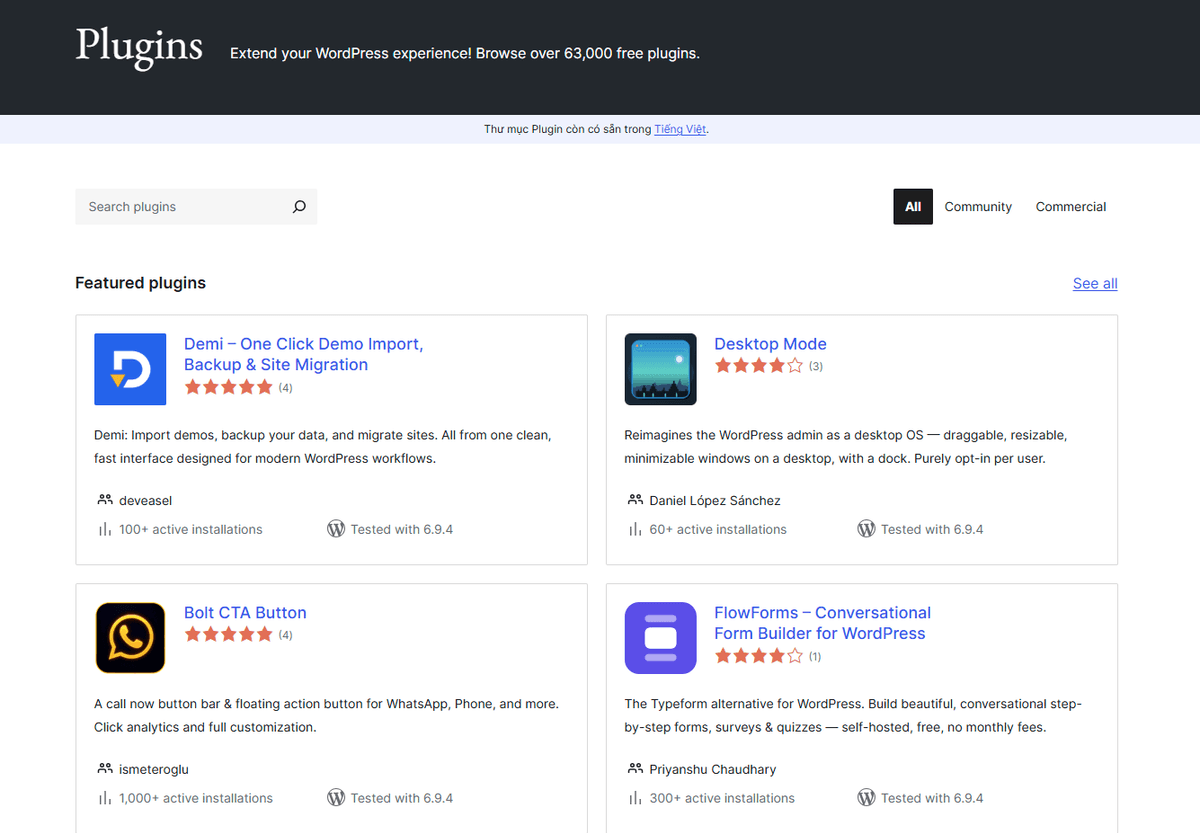
WordPress offers access to over 63,000 plugins in the official repository, with thousands more available commercially. The sheer volume provides almost unlimited functionality, but quality control is uneven - outdated or abandoned plugins are a real security risk. 97% of WordPress security vulnerabilities originate in plugins and themes, not core software (Digital Applied, 2026). Core plugins for WooCommerce stores include:
- Yoast SEO: The leading on-page SEO tool for WordPress, with WooCommerce integration
- Rank Math: A growing alternative to Yoast with more free features
- Elementor: Visual drag-and-drop page builder with WooCommerce widgets
- WooCommerce Subscriptions: Recurring billing for subscription-based products
- WPML: Multilingual store support for international merchants
- CartFlows: Sales funnel builder with one-click upsells for WooCommerce
- WPForms: Form builder for custom checkout fields and lead capture
- MailPoet: Email marketing natively inside WordPress
Many foundational WordPress plugins have robust free tiers, which is a meaningful cost advantage for early-stage stores. However, premium WooCommerce extensions from the official marketplace often carry annual fees, and the cumulative cost of a fully featured WordPress store can rival Shopify once hosting, theme licenses, and premium plugins are totaled.
Verdict on ecosystems: Shopify's app store is curated and ecommerce-focused. WordPress's plugin library is larger and more affordable at entry level but requires more diligence in selection and security maintenance.
Pricing Comparison: The Full Cost of Ownership in 2026
Platform pricing comparisons that only list headline subscription costs are misleading. The true cost of ownership includes hosting, transaction fees, apps or plugins, theme costs, and developer expenses.
Shopify Pricing (US, 2026)
- Basic: $39/month - For solo entrepreneurs; 2 staff accounts, basic reports
- Grow: $105/month - For small teams; 5 staff accounts, standard reports
- Advanced: $399/month - For scaling brands; 15 staff accounts, advanced reports, third-party calculated shipping
- Shopify Plus: Starting at $2,300/month - Enterprise tier for high-volume merchants
Transaction fees of 2% (Basic), 1% (Shopify), and 0.6% (Advanced) apply when using external payment gateways instead of Shopify Payments. These fees are waived entirely when Shopify Payments is used - a significant incentive for merchants in supported countries. Annual billing discounts reduce plan costs by approximately 25%.
WordPress + WooCommerce Pricing
- WordPress software: Free
- WooCommerce plugin: Free
- Shared hosting: $4–$15/mo
- Managed WordPress hosting: $10–$30/month (shared), $30–$100+/month (managed, e.g., Kinsta, WP Engine)
- Premium theme: $50–$200 one-time or annual fee
- WooCommerce extensions: $50–$300/year each for premium extensions
- Security plugin (e.g., Wordfence): Free to $119/year
- Backup solution: $50–$150/year
- Premium SEO plugin (RankMath Pro, Yoast Premium): $99–$229/year
There are no platform-level transaction fees on WooCommerce - merchants pay only standard gateway fees (typically 2.9% + $0.30 for Stripe or PayPal). For high-revenue stores, the absence of platform fees creates a measurable cost advantage over Shopify plans not using Shopify Payments.
Verdict on pricing: WordPress is more cost-effective at startup and for high-volume merchants using third-party payment gateways. Shopify's predictable monthly cost and included infrastructure make budgeting simpler for growing stores. Cumulative TCO at the $1M+ revenue mark is often comparable once WordPress hosting and premium extensions are totaled.
Scalability: Which Platform Grows With Your Business?
Scalability encompasses three dimensions: traffic handling, catalog size, and operational complexity as a business grows.
Shopify Scalability
Shopify's managed infrastructure means that servers, CDN, uptime, and security patches are handled by the platform. During Black Friday / Cyber Monday events - the most demanding traffic period in ecommerce - Shopify's infrastructure handles billions of dollars in transactions across its merchant base simultaneously. Merchants do not need to provision additional server capacity or manage load balancing.
Shopify Plus unlocks additional scalability: multiple storefronts, higher API rate limits, custom checkout extensibility (Checkout Extensions), Shopify Functions, and dedicated merchant success management. Over 47,000 merchants now use Shopify Plus, including Gymshark, Allbirds, Pepsi, and Kylie Cosmetics.
WordPress Scalability
WordPress scales effectively when paired with the right hosting infrastructure. Large-scale WooCommerce stores processing millions in revenue exist and perform reliably - but reaching that performance requires deliberate investment in hosting tier upgrades, caching configurations (WP Super Cache, W3 Total Cache, or server-level caching), CDN integration, and database optimization. The merchant bears responsibility for recognizing when the current hosting plan is a bottleneck and acting before it affects the customer experience. Managed WordPress hosts like Kinsta and WP Engine simplify much of this, but cost increases as traffic grows.
Verdict on scalability: Shopify scales with less operational overhead. WordPress scales with more control but more responsibility.
Migration Pathways: Switching Between Platforms
WooCommerce → Shopify: According to StoreLeads (Feb 2026), WooCommerce is the largest source of merchants switching to Shopify, with 9,198 stores migrating in a single 90-day window. Shopify's Store Importer app handles products, customers, and orders natively. Typical migration timeline: 2–6 weeks for a mid-sized catalog, depending on URL redirect mapping and theme rebuild.
Shopify → WooCommerce: Less common but real - typically driven by merchants seeking lower transaction fees at scale or full data ownership. Migration tools like Cart2Cart and LitExtension automate product, customer, and order transfer. Plan for 4–8 weeks including theme development and thorough testing.
Some merchants run WordPress for content + brand authority and use Shopify as a headless commerce backend via the Storefront API. This captures WordPress's SEO and content advantages with Shopify's checkout reliability - at the cost of integration complexity.
Verdict: Which Merchant Are You?
The Shopify vs WordPress decision maps cleanly onto specific business profiles. Here is a direct framework for making the call.
Choose Shopify if:
- The primary goal is selling physical or digital products and the store is the core business
- Speed to market matters - a functional store is needed within days, not weeks
- Technical maintenance, security patching, and hosting management are not areas of interest or expertise
- The business relies on Shopify-native advantages: Shop Pay, Shopify POS, Shopify Shipping, or multi-channel selling across social commerce and marketplaces
- Predictable, all-inclusive monthly costs are preferable to variable infrastructure expenses
- High-traffic flash sales, seasonal peaks, or rapid scaling are anticipated
Choose WordPress + WooCommerce if:
- Content marketing, blogging, and SEO are central to the customer acquisition strategy - content and commerce are deeply intertwined
- Full ownership of the platform, data, and codebase is a non-negotiable requirement
- Developer resources are available in-house or through an agency relationship
- The store requires deep customization that exceeds Shopify's theme and app constraints
- The business operates internationally with multilingual requirements and complex tax structures
- Budget at startup is limited and the free software layer meaningfully reduces initial investment
- The business model involves complex subscriptions, memberships, or digital licensing that benefit from WordPress's flexible plugin architecture
The Hybrid Reality
Some merchants run a WordPress site for content and brand authority while embedding a Shopify Buy Button or using Shopify as a headless commerce backend. This hybrid approach captures the SEO and content advantages of WordPress with Shopify's checkout performance and infrastructure reliability - though it adds integration complexity and cost.
Conclusion: Make the Decision That Matches Your Business, Not the Trend
The Shopify vs WordPress debate does not have a universal winner in 2026. Shopify is the faster, more managed, and more ecommerce-optimized platform for merchants who want to focus entirely on growth and customer acquisition without managing technical infrastructure. WordPress with WooCommerce is the more flexible, ownership-first platform for merchants who prioritize content-driven SEO, full data control, and deep customization - and who have the resources to maintain that environment.
The worst outcome is choosing a platform for the wrong reasons - picking WordPress because it sounds more powerful without the developer support to use that power, or choosing Shopify and then fighting against its constraints when a highly customized experience is genuinely required. Map the platform to the business model, not the other way around. The platform that best matches how the business actually operates and acquires customers will consistently outperform the technically superior option running against the grain of how the business works.
Frequently Asked Questions
Can I use Shopify and WordPress together?
Yes. Common hybrid setups include: (1) WordPress for the marketing site + blog, with a Shopify Buy Button or Storefront API embedding products; (2) Headless Shopify with a WordPress-managed content layer; (3) Subdomain split (e.g., blog.brand.com on WordPress, brand.com on Shopify). Hybrid setups add integration complexity and require careful canonical and redirect handling for SEO.
Which is more secure: Shopify or WordPress?
Shopify is more secure by default because security is fully managed - patches, PCI DSS compliance, SSL, and DDoS protection are handled by the platform. WordPress can be equally secure but requires active management: regular core/plugin/theme updates, a web application firewall (Wordfence, Sucuri), strong hosting, and disciplined access controls. 97% of WordPress vulnerabilities originate in plugins, not core - plugin discipline is the single biggest security factor.
Which platform is better for dropshipping?
Shopify is generally better for dropshipping due to native integrations with DSers, Spocket, Zendrop, and Printful, plus simpler order routing. WooCommerce supports dropshipping through plugins like AliDropship and WooDropship but requires more configuration. For dropshipping-first business models, Shopify is the practical default.
Is Shopify cheaper than WordPress in the long run?
For merchants under ~$200K annual revenue using Shopify Payments, Shopify is often cheaper or break-even after factoring in WordPress hosting, premium plugins, and developer time. For merchants over $1M in revenue using third-party payment gateways, WooCommerce typically becomes cheaper because there's no platform transaction fee. Plus-tier Shopify and managed WordPress hosting are roughly comparable at enterprise scale.
1781843119189.png&w=3840&q=75)
![Best Shopify Pop-ups App in 2026 [+ Comparison Table]](/_next/image?url=https%3A%2F%2Fapi-wix.letsmetrix.com%2Fuploads%2FBestShopifyPopupApps1753692269470.png&w=3840&q=75)
![9 Best Shopify Translation Apps in 2026 [Expert Reviews]](/_next/image?url=https%3A%2F%2Fapi-wix.letsmetrix.com%2Fuploads%2FBestShopifyTranslationApps(1)1772099410877.png&w=3840&q=75)
![7 Best Shopify Inventory Management Apps in 2026 [Expert Reviews]](/_next/image?url=https%3A%2F%2Fapi-wix.letsmetrix.com%2Fuploads%2FShopifyInventoryManagementApps1769568798368.jpg&w=3840&q=75)
![10 Best Shopify Page Builder Apps in 2026 [Real Ratings & Use Cases]](/_next/image?url=https%3A%2F%2Fapi-wix.letsmetrix.com%2Fuploads%2Fshopifypagebuilderapps(1)1766045668400.png&w=3840&q=75)

1781062586886.png&w=3840&q=75)
1781252894352.png&w=3840&q=75)
1779178565213.png&w=3840&q=75)
1779079852354.png&w=3840&q=75)
1778146500970.png&w=3840&q=75)
1778052641749.png&w=3840&q=75)
1778220787051.png&w=3840&q=75)
1777884794983.png&w=3840&q=75)
1777446574562.png&w=3840&q=75)
1777436136439.png&w=3840&q=75)