
Shopify vs Squarespace 2026: Best eCommerce Platform for Scale?
Choosing between Shopify and Squarespace is one of the highest-stakes decisions an online merchant will make in 2026. Get it right, and your platform becomes the engine behind scalable revenue, strong SEO performance, and a seamless customer experience. Get it wrong, and you're locked into a system that fights your growth at every turn. This guide is built for merchants - not hobbyists - who need an unbiased, experience-backed breakdown of both platforms to make a confident, data-informed decision.
The analysis here draws from real platform capabilities, published pricing structures, and documented merchant outcomes across product-based businesses, service sellers, and hybrid commerce brands. Whether you're launching your first store or migrating an existing one, this comparison covers everything that matters: ease of use, features, app ecosystems, pricing, and long-term scalability.
TL;DR: Shopify vs Squarespace at a Glance
Category | Shopify | Squarespace |
|---|---|---|
Best For | High-volume product sellers, DTC brands, dropshippers | Creatives, service providers, small boutiques |
Founded | 2006 (Ottawa, Canada) | 2003 (USA) |
Starting Price | $29/mo (Basic, annual billing) | $16/mo (Personal — no ecommerce) |
Ecommerce Entry Point | $29/mo | $23/mo (Business) |
Transaction Fees | 0% with Shopify Payments; up to 2% with third-party processors | 0% on Core, Plus, Advanced |
App/Extension Count | 20,000+ apps | Hundreds of curated extensions |
Design Flexibility | Solid, commerce-first templates | Award-winning, design-forward templates |
SEO Capabilities | Strong — structured for product and collection pages | Solid — clean markup, strong for content-heavy sites |
Scalability | Enterprise-grade (Shopify Plus) | Limited above mid-tier volume |
Multi-Channel Selling | Native — Amazon, TikTok, Instagram, Google, POS | Limited to select social integrations |
Ideal Catalog Size | Unlimited SKUs | Best under a few hundred SKUs |
Two Platforms, One Goal - But Very Different Paths to Get There
There is no universally perfect ecommerce platform. There is only the platform that is perfectly aligned with how your specific business operates, grows, and earns. Understanding where Shopify and Squarespace diverge - and where they overlap - is the foundation of a smart platform decision.
Shopify was built from the ground up as a commerce operating system. Launched in 2006 after founder Tobias Lütke struggled to sell snowboards online using existing tools, Shopify was designed with one purpose: to make selling products online as frictionless as possible at any scale. Today, Shopify powers over 2.8 million merchants across 175 countries and processes hundreds of billions in annual commerce volume.
Squarespace started as a website builder for creatives and professionals. Its ecommerce capabilities were layered in later and have improved significantly, but the platform's DNA remains oriented around visual storytelling, portfolio presentation, and service-based businesses. Squarespace powers millions of websites globally and is particularly dominant among photographers, designers, authors, and boutique-style product shops.
The stakes of this choice extend far beyond launch day. Your platform determines which payment processors you can use, what your SEO ceiling looks like for product and category pages, how much of your revenue disappears in transaction fees, and whether your tech stack can survive a 10x traffic spike. Choosing the wrong platform in 2026 can mean months of migration costs and lost organic rankings - both of which compound over time.
Ease of Use: Which Platform Gets You Selling Faster?
Both platforms are marketed as beginner-friendly, but the experience diverges quickly once you move beyond the homepage.
Shopify's Onboarding Experience
Shopify's admin dashboard is purpose-built for commerce. The onboarding flow walks new merchants through adding products, setting up payment methods, configuring shipping zones, and connecting a domain - in that order, because that is the order in which merchants need to act. The interface is clean and task-oriented: every menu item maps directly to a merchant action (Orders, Products, Customers, Analytics, Marketing).
The theme editor uses a drag-and-drop section editor that is intuitive without being oversimplified. Merchants can customize product page layouts, add trust badges, configure collection filters, and adjust checkout colors without touching code. For advanced customization, Shopify uses its own Liquid templating language, and a large developer ecosystem means custom work is accessible and well-documented.
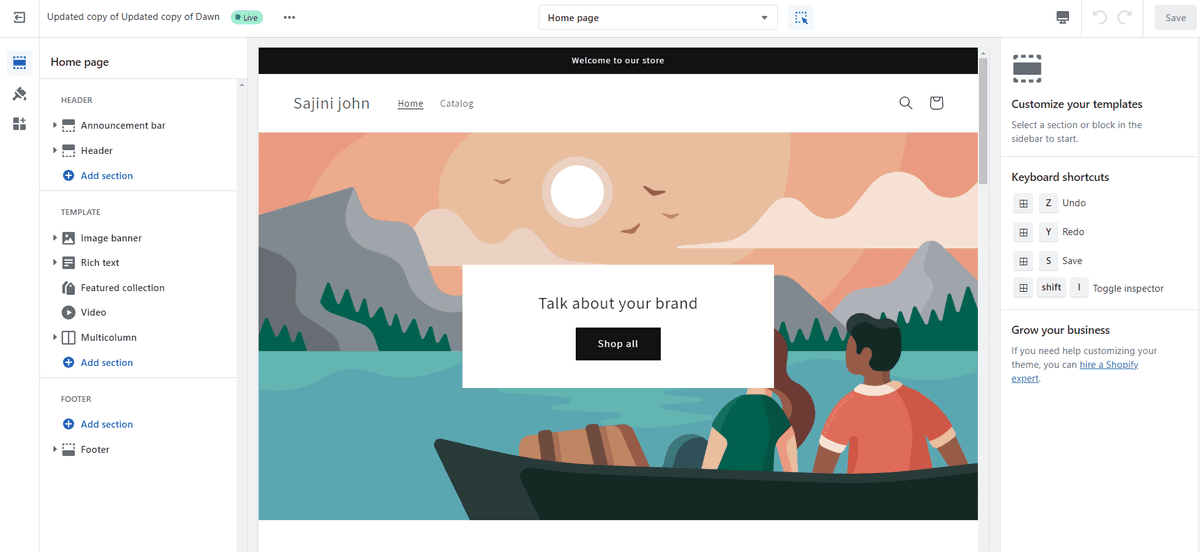
Where Shopify has a learning curve is in app management. Because the platform's core feature set is extended primarily through apps, new merchants often need to install, configure, and troubleshoot third-party tools to unlock functionality that feels like it should be native. This is a known tradeoff - depth in exchange for a slightly steeper ramp.
Squarespace's Onboarding Experience
Squarespace's editor is visually stunning and among the most intuitive website builders available. The drag-and-drop interface gives users real-time visual feedback, and the template library is exceptional - particularly for brands where aesthetics are central to the product experience (jewelry, apparel, food, photography).

For ecommerce specifically, Squarespace's setup is simpler than Shopify's but less powerful by design. Adding products, setting prices, and configuring basic shipping is straightforward. However, merchants who need multi-currency support, advanced inventory management, or complex shipping rules will hit configuration walls faster on Squarespace than on Shopify.
Verdict on Ease of Use: Squarespace wins on pure visual design experience. Shopify wins on commerce-specific workflow efficiency. For merchants whose primary need is selling products at scale, Shopify's interface will feel more natural after the first week.
Shopify vs Squarespace Features and Flexibility
Core Commerce Features
Shopify's native feature set is built around the full commerce lifecycle: product management with unlimited variants, inventory tracking across multiple locations, built-in abandoned cart recovery, discount codes and automatic discounts, gift cards, multi-currency selling, and a fully customizable checkout. Shopify also includes a native point-of-sale system (Shopify POS) that syncs online and offline inventory in real time - a feature critical for omnichannel merchants.
Squarespace's Commerce plans include product pages, inventory management, coupon codes, digital product delivery, and subscription product support. The platform handles a clean, simple shopping cart and checkout experience. However, Squarespace lacks native POS depth, has no multi-location inventory, and offers more limited discount logic compared to Shopify.
SEO Capabilities
Both platforms produce clean, indexable HTML. Shopify generates structured product and collection page URLs, supports canonical tags, allows custom meta titles and descriptions at the product level, and integrates cleanly with Google Search Console and Merchant Center. Shopify's URL structure for collections and products is logical and SEO-friendly by default.
Squarespace produces clean markup as well and gives users control over page titles, meta descriptions, and alt text. Its blogging functionality is strong, which supports content-driven SEO strategies. However, Squarespace has historically been more limited in advanced technical SEO customization - schema markup injection, custom robots.txt editing, and log file access are more restricted than on Shopify.
Multi-Channel Selling
Shopify's multi-channel capabilities are a major differentiator in 2026. Merchants can sell natively on Amazon, eBay, TikTok Shop, Instagram and Facebook Shops, Pinterest, and Google Shopping - all from a single Shopify admin. Inventory, orders, and customer data sync across channels automatically.
Squarespace supports Instagram and Facebook shopping integrations and has limited Pinterest connectivity. It does not offer native Amazon or eBay selling, and multi-channel management is not a core part of the Squarespace value proposition.
The App Ecosystem: Extending What Your Platform Can Do
The app marketplace is where the platform divide becomes most consequential for growing merchants. It determines how much of your growth strategy is achievable within your platform versus how much requires workarounds or platform migration.
Shopify App Store: 20,000+ Solutions
The Shopify App Store is the most comprehensive ecommerce app marketplace available on any platform. With over 20,000 apps spanning every category of commerce operations, merchants can extend Shopify to handle virtually any use case without custom development.
Notable high-impact apps in the Shopify ecosystem include:
- Omnisend — email and SMS marketing automation for segmentation and flows
- Yotpo — product reviews, loyalty programs, and user-generated content
- DSers — dropshipping order management and AliExpress supplier sourcing
- QuoteSnap — For B2B or anyone needing to hide prices & quote request.
- Appstle℠ Subscriptions — recurring revenue and subscription box management
- Printful — print-on-demand fulfillment with direct Shopify sync
- Synctrack — Stripe & PayPal Sync Tracking
- Gorgias — ecommerce-native customer support helpdesk
The depth and competition within the Shopify App Store also drives pricing down and quality up. Most categories have multiple competing solutions at different price points, giving merchants genuine optionality.
Squarespace Extensions: Quality Over Quantity
Squarespace offers a curated set of extensions - a deliberate choice that keeps the integration experience cleaner but limits flexibility. The extensions available cover core merchant needs but with less depth than Shopify's ecosystem.
Top Squarespace extensions include:
- Printful — print-on-demand product fulfillment
- ShipBob — third-party logistics and fulfillment
- Avalara — automated sales tax calculation and compliance
- Mailchimp — email marketing list sync
For merchants with straightforward needs, Squarespace's native feature set combined with its extensions is sufficient. For merchants who need advanced marketing automation, subscription billing, loyalty programs, or complex fulfillment logic, the extension library runs thin quickly.
Shopify vs Squarespace Pricing: True Cost for Real Merchants
1777443467059.png&w=1200&q=75)
Sticker price and true cost diverge significantly on both platforms once apps, transaction fees, and theme costs are factored in.
Plan | Shopify | Squarespace |
|---|---|---|
Entry Commerce | Basic — $39/mo (monthly) or $29/mo (annually) | Core — $23/mo |
Mid-Tier | Grow — $105/mo (monthly) or $79/month (annually) | Plus — $39/mo |
Advanced | Advanced — $399/month (monthly) or $299/month (annually) | Advanced — $99/mo |
Enterprise | Plus — from $2,300/mo | Not available |
Transaction Fees | 0% (Shopify Payments); 0.6%–2% (third-party) | 0% (Commerce plans) |
Themes | Free themes available; premium themes $100–$500 (one-time) | All templates included in subscription |
Squarespace appears less expensive at face value, and for low-volume merchants it genuinely is. However, the app costs that Shopify merchants absorb — email marketing platforms, review tools, upsell apps — often replace functionality that would otherwise require custom development or simply isn't available on Squarespace at all. At moderate to high revenue volumes, Shopify's transaction fee structure (0% with Shopify Payments) can offset its higher base plan costs compared to using third-party processors on either platform.
Merchants processing above $100,000 in annual revenue should run a detailed total cost of ownership model before choosing based on plan price alone. The platform that charges less per month is not necessarily the platform that costs less to operate at scale.
Scalability: Which Platform Grows With Your Business?
Scalability is the dimension where the platforms diverge most sharply - and where the long-term cost of a wrong decision becomes most apparent.
Shopify's Scalability Ceiling
Shopify was engineered for scale. The infrastructure handles flash sales, viral traffic events, and high-volume product launches without requiring merchant-side server management. Shopify Plus, the enterprise tier, serves brands processing hundreds of millions in annual revenue and offers features including custom checkout scripting, dedicated merchant success management, multi-store management, B2B wholesale functionality, and Shopify Functions for custom logic without app dependencies.
Brands that start on Shopify Basic can migrate to Grow or Advanced plans as their needs grow, and ultimately to Shopify Plus - all without changing platforms, migrating data, or re-building storefronts. This vertical scalability is one of Shopify's most commercially important features.
Squarespace's Scalability Reality
Squarespace scales comfortably for small to mid-size businesses with manageable product catalogs and predictable traffic. The Commerce Advanced plan supports subscription products, advanced shipping rules, abandoned cart recovery, and limited API access. For merchants in this tier, Squarespace is a capable and cost-effective platform.
However, Squarespace does not have an enterprise offering comparable to Shopify Plus. Merchants who reach high order volumes, need multi-warehouse fulfillment, require custom checkout flows, or want to manage multiple storefronts from a single admin will outgrow Squarespace and face a migration. That migration - along with its associated SEO risks from URL structure changes, redirects, and potential ranking volatility - is a real cost that should be factored into the initial platform decision.
For businesses that project significant growth within three to five years, the practical scalability ceiling of Squarespace is a meaningful constraint.
Shopify vs Squarespace: Which Merchant Are You?
The right platform depends entirely on the type of merchant making the decision. Here is a direct breakdown:
Choose Shopify if:
- Your primary business model is selling physical or digital products at volume
- You plan to sell across multiple channels (Amazon, TikTok, Instagram, physical retail)
- You want access to the deepest app ecosystem for marketing, fulfillment, and retention
- You are building a brand with long-term growth ambitions and need a platform that scales without re-platforming
- You need advanced inventory management, multi-location tracking, or B2B capabilities
- You are running a dropshipping or print-on-demand business model
Choose Squarespace if:
- Your business is design-forward - photography, art, fashion, food, or creative services
- You sell a small, curated catalog alongside service offerings or digital content
- Your ecommerce volume is low to moderate and growth projections are steady rather than aggressive
- Design aesthetics are a core part of your brand differentiation and customer experience
- You want an all-in-one website, portfolio, blog, and store on a single platform without managing multiple tools
- Budget is a primary constraint and your catalog and feature needs are straightforward
Final Call: Platform Choice Is a Business Decision, Not a Tech Decision
The Shopify vs Squarespace comparison ultimately resolves to a question about business model, not software preference. Both platforms are well-built, actively maintained, and capable of generating real revenue for the right type of merchant.
Shopify is the dominant choice for merchants who are serious about commerce at scale. Its infrastructure, app ecosystem, multi-channel capabilities, and enterprise track record make it the most commercially capable platform available for product-first businesses in 2026. The higher base cost and app investment are justified when revenue volume and growth ambitions align with what the platform enables.
Squarespace is the right choice for businesses where commerce is one component of a broader digital presence - where visual brand storytelling, content publishing, and service booking matter as much as the shopping cart. For those merchants, Squarespace's elegance, simplicity, and competitive pricing deliver genuine value that Shopify cannot match at equivalent cost.
The most expensive mistake is not choosing the pricier platform - it is choosing the wrong one and migrating eighteen months later. Map your business model to the platform built for it, and the investment pays forward in every sale, every ranking, and every customer retained.
![Best Shopify Pop-ups App in 2026 [+ Comparison Table]](/_next/image?url=https%3A%2F%2Fapi-wix.letsmetrix.com%2Fuploads%2FBestShopifyPopupApps1753692269470.png&w=3840&q=75)
![9 Best Shopify Translation Apps in 2026 [Expert Reviews]](/_next/image?url=https%3A%2F%2Fapi-wix.letsmetrix.com%2Fuploads%2FBestShopifyTranslationApps(1)1772099410877.png&w=3840&q=75)
![7 Best Shopify Inventory Management Apps in 2026 [Expert Reviews]](/_next/image?url=https%3A%2F%2Fapi-wix.letsmetrix.com%2Fuploads%2FShopifyInventoryManagementApps1769568798368.jpg&w=3840&q=75)
![10 Best Shopify Page Builder Apps in 2026 [Real Ratings & Use Cases]](/_next/image?url=https%3A%2F%2Fapi-wix.letsmetrix.com%2Fuploads%2Fshopifypagebuilderapps(1)1766045668400.png&w=3840&q=75)

1781062586886.png&w=3840&q=75)
1781252894352.png&w=3840&q=75)
1779178565213.png&w=3840&q=75)
1779079852354.png&w=3840&q=75)
1778146500970.png&w=3840&q=75)
1778052641749.png&w=3840&q=75)
1778220787051.png&w=3840&q=75)
1777884794983.png&w=3840&q=75)
1777446574562.png&w=3840&q=75)
1777436136439.png&w=3840&q=75)
1777368900479.png&w=3840&q=75)
(1)1776226010776.png&w=3840&q=75)
![Top 7 Klaviyo Alternatives and Competitors in 2026 [with Real Ratings]](/_next/image?url=https%3A%2F%2Fapi-wix.letsmetrix.com%2Fuploads%2FKlaviyoAlternatives(1)1775801269772.png&w=3840&q=75)