
How Your Pricing Model Drives Your Shopify App Store Rankings
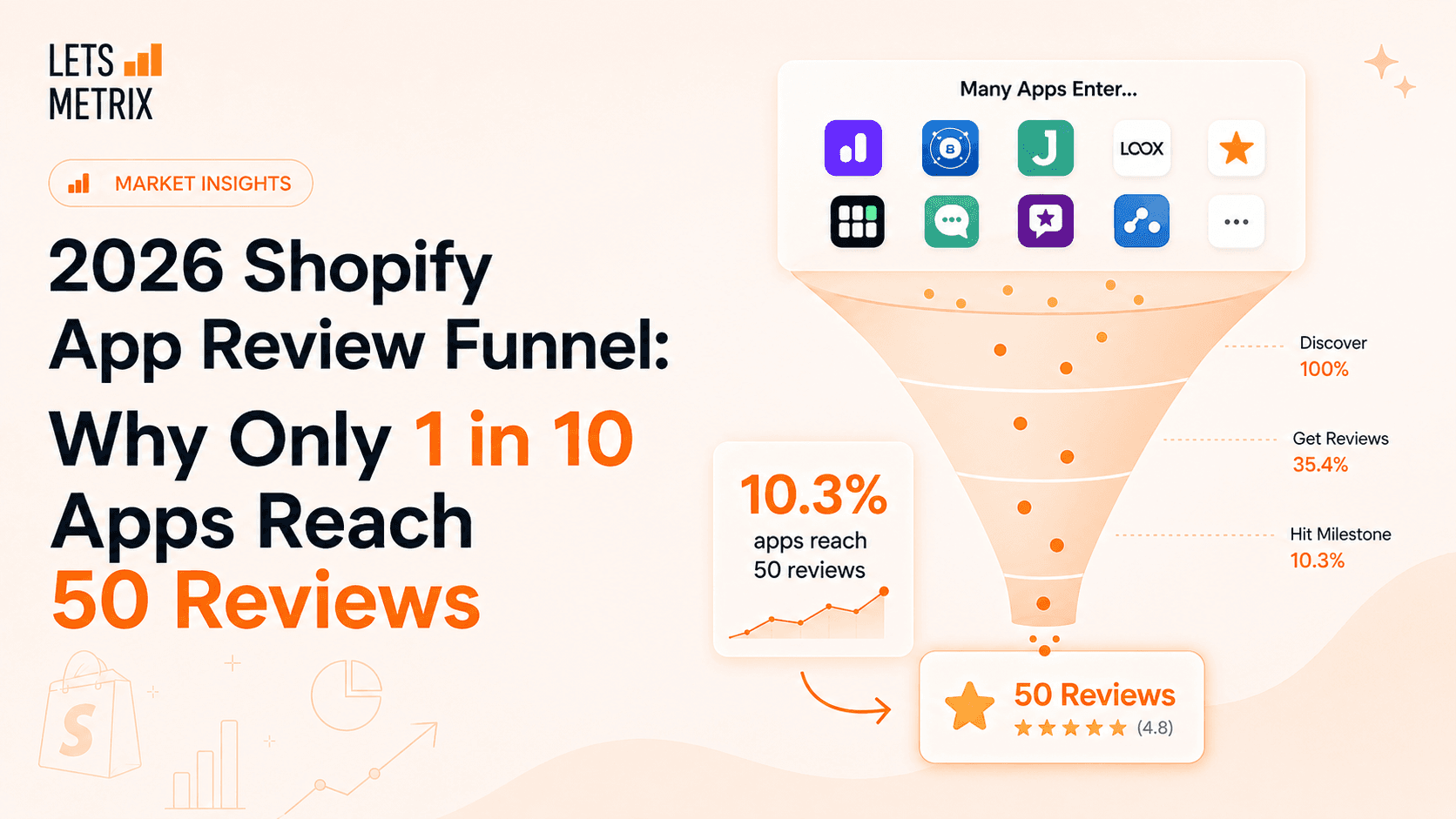
Winning organic visibility in the Shopify App Store SEO game is, before anything else, a race against the clock. Keeping an app alive on the store is the easy part - roughly 3 in 4 apps survive. The hard part is proof: only about 10.3% of active apps ever cross the 50-review threshold, the point where Shopify's search algorithm starts ranking them seriously. Most founders design their pricing around revenue. But Q2 2026 marketplace data from the LetsMetrix Shopify App Market Report reveals something most launch plans miss: your pricing structure quietly controls how many days it takes to reach the review milestones that unlock ranking. Choose the wrong monetization model and you can add over 200 days to your ranking timeline.
This guide breaks down the exact impact of Freemium, Paid-Only, and Free-Only models on review acquisition speed - and gives you a pricing-led growth strategy for 2026.
What you’ll learn in this article:
- How the Shopify App Store splits into three near-equal pricing models
- The exact "time to 50 reviews" for Freemium, Free-Only, and Paid-Only app
- Why "free" quietly hurts your star rating and your rankings
- The $10–$30 pricing sweet spot that produces the happiest merchants
- Three actionable monetization strategies to shorten your ranking timeline
Data source: LetsMetrix Q2 2026 Shopify App Global Market Report, based on a live crawl of the public Shopify App Store (Apr–Jun 2026). Figures are medians and count only apps that reached each milestone.
Understanding the Shopify Pricing Landscape
The modern Shopify App Store no longer has a "default" way to charge. As of Q2 2026, monetization is split almost perfectly into three camps, and no single model owns the market.
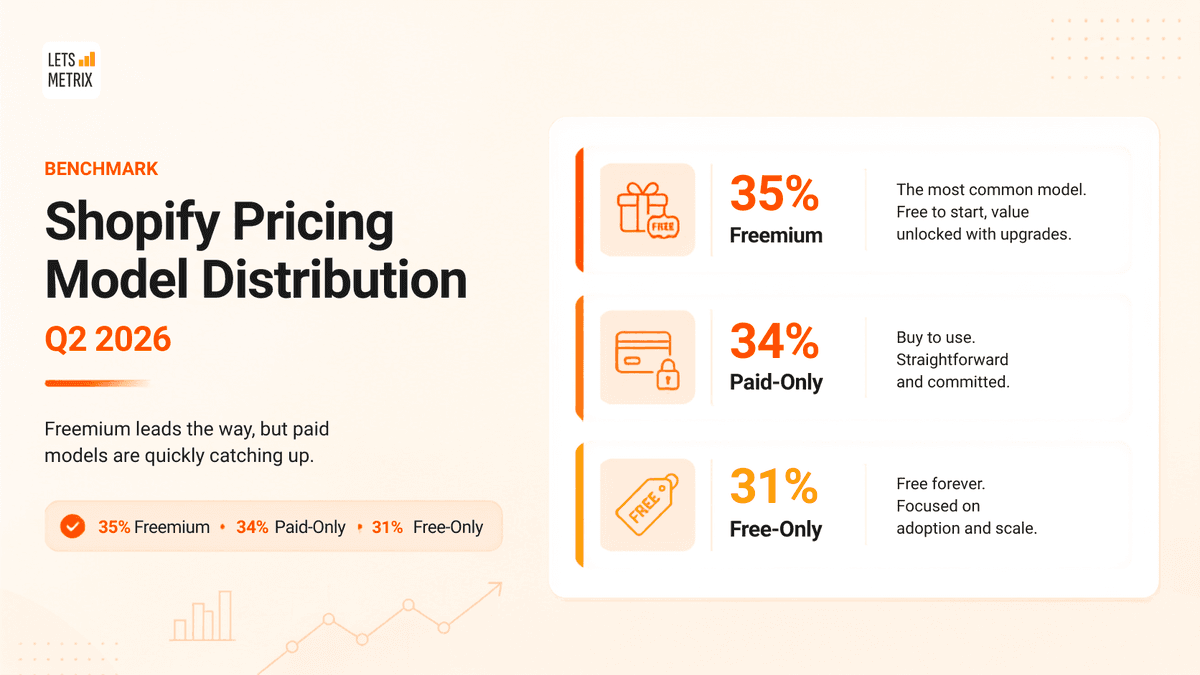
The takeaway for founders is subtle but important: there is no auto-win pricing structure. When every model holds roughly a third of the store, the question stops being "What should I charge?" and becomes "How does my pricing structure encourage - or discourage - merchants from leaving a review?" That reframing is the entire basis of app store optimization metrics in 2026. Reviews are the currency of ranking, and your price tag is the mechanism that either speeds review collection up or slows it to a crawl.
Pricing Model vs. Review Speed: The Race to 50 Reviews
Here is the single most actionable finding in the report. When you measure the median time to 50 reviews - the traction milestone that matters for Shopify app store SEO - the three pricing models produce dramatically different timelines.
Pricing Model | Median Time to 50 Reviews | Speed vs. Paid-Only | Best Use Cas |
|---|---|---|---|
Freemium | 407 days (~13.4 months) | 35% faster (fastest) | Volume-driven categories; the fastest ASO climb |
Free-Only | 448 days (~14.7 months | 28% faster | Weak as a standalone model - better as a funnel entry |
Paid-Only | 624 days (~20.5 months) | Baseline (slowest) | High-intent, return-driven, and B2B categories |
1. Freemium: The Speed Champion
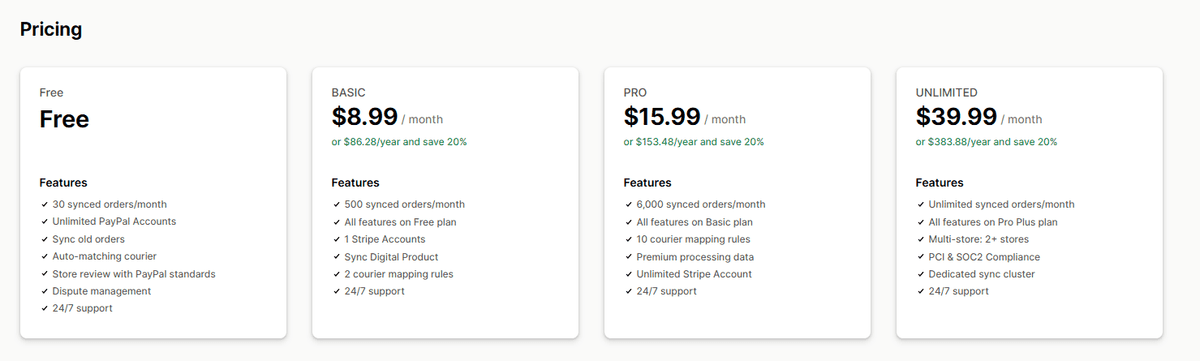
Freemium apps reach the 50-review ranking milestone in a median of 407 days (about 13.4 months) - the fastest of any model. The mechanism is simple: a free tier acts as an install-volume supercharger. By removing the friction to download, you build a large user base at the top of your funnel, and a bigger base of active merchants means a bigger pool of potential reviewers feeding your review-collection engine. If your primary goal is climbing Shopify search results as quickly as possible, Freemium is the most efficient launch framework in the store today.
2. Free-Only: The Unproductive Middle Ground
Free-only apps take a median of 448 days (about 14.7 months) to hit 50 reviews - only marginally slower than Freemium, yet the outcome is far weaker. Free-only apps secure plenty of installs, but users feel almost no transactional relationship or emotional investment in the software. Without a value-based upgrade path or premium features to anchor the relationship, merchants simply have little reason or incentive to leave a review at all. You get the installs but not the advocacy - which is why a purely free model is the classic Shopify app traction trap.
3. Paid-Only: The Long, High-Intent Slog
Paid-only apps take a median of 624 days (about 20.5 months) to reach 50 reviews - more than seven months longer than their freemium competitors. The dynamic is a trade-off. A paid gate shrinks your user base, which bottlenecks raw review volume. But the merchants who do pay are high-intent buyers who review at a much higher rate relative to install numbers. Paid-only is slower on the clock, but it self-selects for committed customers - and that matters enormously for your rating, as the next section shows.
The "Free is Cheap" Contradiction: Pricing vs. Merchant Satisfaction
Speed to 50 reviews is only half the ranking equation. The other half is the quality of those reviews - your star rating. And here the data flips the intuition that "free = loved" completely on its head.
Free-Only Apps Sit at the Bottom of Customer Satisfaction
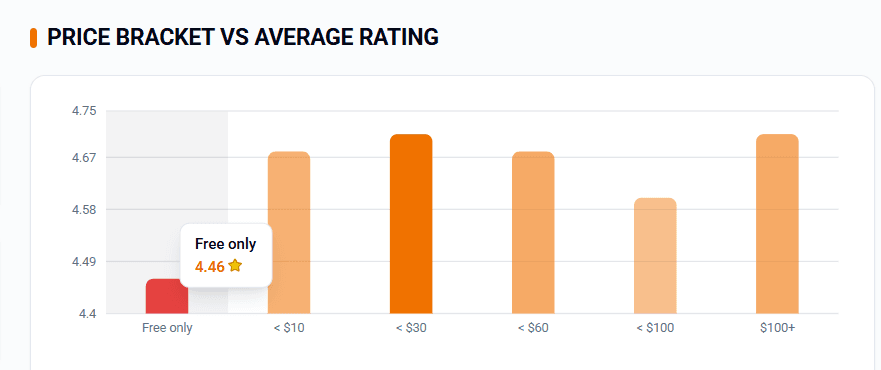
Free-only apps hold the lowest average rating in the entire ecosystem, at 4.45 stars. The psychology is familiar to anyone who has run a support desk: "free" often equates to "disposable." Merchants are quicker to leave a harsh 1-star rating over a minor setup bug on a free app, in part because free-only developers rarely have the funding to staff dedicated, real-time support. Low price, low expectations, low patience - and a rating that quietly drags your ranking down.
The $10–$30 Sweet Spot: Happier Users, Better Ratings
Apps priced between $10–$30/month post the highest average rating in the store at 4.71 stars. Even premium apps at $100+/month (4.69) score meaningfully higher than free-only ones. Paying a small, reasonable amount aligns merchant expectations with professional support and a maintained product - and supported merchants leave better reviews. Those higher ratings insulate your app from the ranking drops that a slide toward 4.4 stars can trigger.
👉 Read the two datasets together and the strategy writes itself: Freemium gives you the speed to 50 reviews, while a paid tier in the $10–$30 range gives you the rating that keeps you there. The winning apps do both.
Actionable Monetization & Ranking Strategies for Shopify App Developers
Use a "Freemium-to-Sweet-Spot" Funnel
Launch with a freemium model to build a fast-moving install funnel and reach your first 50 reviews as quickly as possible - roughly 200 days sooner than a paid-only competitor. Then price your premium tiers squarely in the $10–$30/month range to capture the highest-satisfaction pricing band. This is the best of both worlds: freemium speed on the way up, sweet-spot ratings once you are there, and stable recurring revenue underneath it all. It is the closest thing the Q2 2026 data offers to a repeatable Shopify app store SEO playbook.
Treat Free-Tier Users as a Marketing Channel
Do not treat your free tier as the whole business - treat it as a review-generation engine. The most under-used lever here is timing. The report shows reviews arrive in two waves: about 25% land within a day of install (often frustrated first impressions), while the single largest share - 40% - arrives only after 90 days.
- Trigger on the success moment, not on install: fire an in-product review prompt right after a merchant completes a genuine win inside the app, not during onboarding when opinions are premature.
- Add a 90-day reminder: a gentle nudge around the three-month mark captures the biggest wave of reviews and is one of the most overlooked opportunities in the data.
- Stay inside Shopify's rules: use neutral wording, never incentivize or ask only for positive reviews, and avoid unsolicited email requests - all of which can get reviews removed or your listing demoted.
Play "Paid-Only" Exclusively in High-Intent Categories
Paid-only is the slow lane on review velocity, so reserve it for the categories where it pays off. In complex, return-driven, or deep B2B niches - advanced shipping, loyalty and rewards, checkout logic - buyer intent is high and merchants are used to paying for serious tools. In those categories, lean paid-only, budget for a longer 20-month climb to 50 reviews, and invest heavily in high-touch support to protect the star rating that paid users expect. Slower reviews, but stronger ones.
Aligning Your App Price with Your Ranking Timeline
E-commerce SaaS growth is a balancing act between monetization and platform visibility, and pricing is the hinge between them. Freemium models get you ranked roughly 35% faster than paid-only ones by feeding your review funnel with volume - but pricing your premium tiers correctly, in the $10–$30 band, is what keeps your ratings high enough to hold those rankings. Your pricing model isn't just a revenue decision; it's your review engine. Design it that way. To pressure-test your own numbers against the full benchmarks, explore the 2026 Shopify App Market Report or run a free Shopify ASO Audit on LetsMetrix.
Frequently Asked Questions
How long does it take to get 50 reviews on the Shopify App Store?
Across all pricing models, the median app that reaches 50 reviews takes about 468 days (roughly 15 months). Freemium apps are fastest at 407 days, free-only apps take 448 days, and paid-only apps take 624 days. And that only counts the apps that get there at all - just 10.3% of active apps ever cross 50 reviews.
Which Shopify app pricing model gets reviews the fastest?
Freemium. It reaches 50 reviews in a median of 407 days because a free tier removes install friction and builds a large base of potential reviewers - about 35% faster than a paid-only model.
Do free Shopify apps rank worse than paid ones?
Indirectly, yes. Free-only apps hold the lowest average rating in the store (4.45 stars), and a lower rating weakens your ranking and conversion. Apps priced $10–$30/month rate highest at 4.71 stars, so a small paid tier tends to correlate with better ratings and steadier rankings.
1783332249856.png&w=3840&q=75)
1783310383371.png&w=3840&q=75)
1781843119189.png&w=3840&q=75)
![Best Shopify Pop-ups App in 2026 [+ Comparison Table]](/_next/image?url=https%3A%2F%2Fapi-wix.letsmetrix.com%2Fuploads%2FBestShopifyPopupApps1753692269470.png&w=3840&q=75)
![9 Best Shopify Translation Apps in 2026 [Expert Reviews]](/_next/image?url=https%3A%2F%2Fapi-wix.letsmetrix.com%2Fuploads%2FBestShopifyTranslationApps(1)1772099410877.png&w=3840&q=75)
![7 Best Shopify Inventory Management Apps in 2026 [Expert Reviews]](/_next/image?url=https%3A%2F%2Fapi-wix.letsmetrix.com%2Fuploads%2FShopifyInventoryManagementApps1769568798368.jpg&w=3840&q=75)
![10 Best Shopify Page Builder Apps in 2026 [Real Ratings & Use Cases]](/_next/image?url=https%3A%2F%2Fapi-wix.letsmetrix.com%2Fuploads%2Fshopifypagebuilderapps(1)1766045668400.png&w=3840&q=75)

1781062586886.png&w=3840&q=75)
1781252894352.png&w=3840&q=75)
1779178565213.png&w=3840&q=75)
1779079852354.png&w=3840&q=75)
1778146500970.png&w=3840&q=75)
1778052641749.png&w=3840&q=75)